
Conventional DC Rail Services
The following recommendations can be made for DC power supply systems for all types of operation (suburban, regional, intercity, freight).
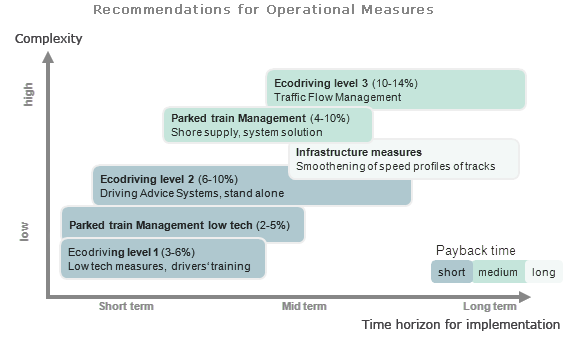
Recommendations for Operational Measures
- An adequate load and temperature management for parked trains is essential, as for AC and diesel trains. There are no major differences to AC.
- Energy optimised driving ("eco driving") is highly promising, like for the other types of power supply (AC, Diesel). Keep in mind that the priorities for the driver are not the same as in AC systems since regenerative braking is not always possible in DC, but rather similar to diesel trains.
Overall energy efficient traffic management will allow significant reductions in energy consumption, as for AC and diesel propulsion as well. Such systems are the only significant development which is clearly beyond "business as usual".
Such a development and its introduction into real rail operation will require joint efforts by infrastructure and train operating companies, rolling stock and signalling equipment manufacturers as well as standardisation bodies and safety authorities. A reasonable degree of standardisation (not too low but not too high) will have to be found to create a way forward with this respect.
Recommendations for Infrastructure
- Consequently integrate costs for energy losses in substations and the catenary system into life cycle cost (LCC) calculations for any change to the DC power supply systems. Corresponding results will influence the optimum design of wire cross sections and selection of materials ("reduced line impedance").
- The integration of reversible substations and/or trackside energy storage units shall be considered for networks with medium traffic density. Their economical evaluation can only be made for individual cases, under precise consideration of network topology, catenary system impedances as well as rolling stock (train mass, speed) and operations (timetable).
- A combination of such measures may result in an optimum e.g. strengthening the catenary system by additional feeders, plus one reversible substation in an ideal location. Rising energy prices may promote such solutions, which are often at the limit of probability today.
- A general increase of the line voltage in DC systems is out of scope, since the limits are clearly defined by the standards (EN 50163). However, an optimisation within these limits is recommended, under consideration of existing possibilities (tap changers in substation transformers, control settings for brake blending recuperation/rheostatic in rolling stock).
- Special systems like the 2 x 1.5-kV DC system may be of interest only for increase of capacity of the power supply system (upgrade of existing systems when traffic is increased). They are always in competition with additional substations and / or lowering catenary impedances. The profitability of the 2 x 1.5-kV DC system must be carefully evaluated against these other solutions, and energy savings are more an interesting side effect than the reason for such investments.
Recommendations for Rolling Stock
- On-board energy storage is not interesting for DC traction unless completely other driving factors require it (e.g. "catenary-less operation" in some politically sensitive areas).
- Use the catenary network as energy storage device. All other on-board measures are similar to the AC conventional recommendations.
- Use the developed TecRec 100_001 "Specification and verification of energy consumption for railway rolling stock" for new projects, as a background for evaluation of technologies or design options.
- Keep in mind that some interesting technologies can be applied also during retrofits for existing rolling stock, e.g. optimum motor and converter control (flux control, PWM patterns, auxiliaries). This can often be done by software, sometimes with minor changes in the hardware e.g. additional contactors. Many of these changes are highly profitable and have short payback times, hence can be applied also to rolling stock with limited life time expectation.