
Recommendations
The Railenergy project gives the following recommendations to the railway sector within the field of system wide energy efficiency:
Standards
In procurement and leasing projects the energy performance of new rolling stock should be predicted and validated by using the UIC/UNIFE TecRec 100_001 developed by Railenergy.
Operational measures
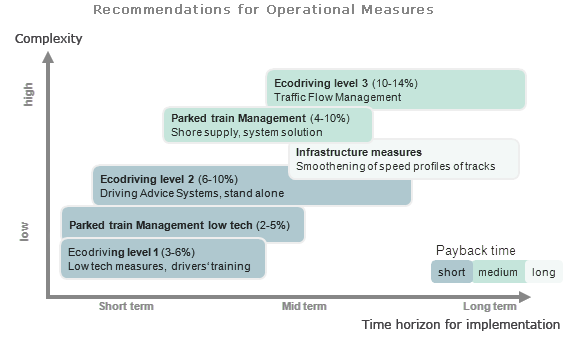
Operational measures – in-service as well as out of service – are always the first and most important to implement as all investigations point towards high savings at relatively low costs compared to technology measures:
- Eco driving (levels 1 and 2, see technology description for details) is highly promising, for all types of power supply. It has a saving potential between 5% and 15% depending on the actual operational regime and on the level of sophistication of the introduced system.
- Energy efficient traffic management (eco-driving level 3) will allow significant reductions in energy consumption in the railway system (between 10% and 20%). The implementation of such systems requires a high degree of cooperation between the different stakeholders - infrastructure managers, train operating companies, rolling stock and signalling equipment manufacturers and standardisation bodies and safety authorities. The needed joint effort goes clearly beyond the "business as usual" scenario. A reasonable degree of standardisation is needed in order to guarantee swift progress in this field.
- Parked train management is a very promising operational measure with a high saving potential (4% to 8%) and comparably low investment costs. In mainly focuses on a more efficient load and temperature management for parked trains and can be realized as a first stage by low tech measures. More complex systemic solutions require higher investments and a higher organisational effort because established processes and habits have to be changed.
Individual energy efficiency investment decisions need careful preparation but for the preliminary screening phase Railenergy has developed the online decision support tool, the “Railenergy Calculator” based on the project methodology, standards and dataset. Explore this Calculator and find all relevant project results on this web page where also additional important and relevant information can be found about the Railenergy methodology and the simulations performed.
It is very important for real savings in energy consumption that incentives for energy efficiency are in place and target the main users appropriately.
Especially two problems have to be addressed:
- involving the infrastructure manager in system energy savings is not yet solved in most EU countries and
- balancing opposing incentives for regional rail service contracts deriving from different time and stakeholder perspectives as contracts are usually rather short compared to the life time of the rolling stock.