
RAILENERGY METHODOLOGY
The Railenergy assessment methodology is a generally accepted and applied approach developed within the Railenergy project. The Railenergy technology assessment framework and methodology consists of transparent assessments at three levels: technical, operational and strategic level. Energy saving data has been simulated, calculated and evaluated to finally be assessed from the operational and strategic perspective – see figure below.
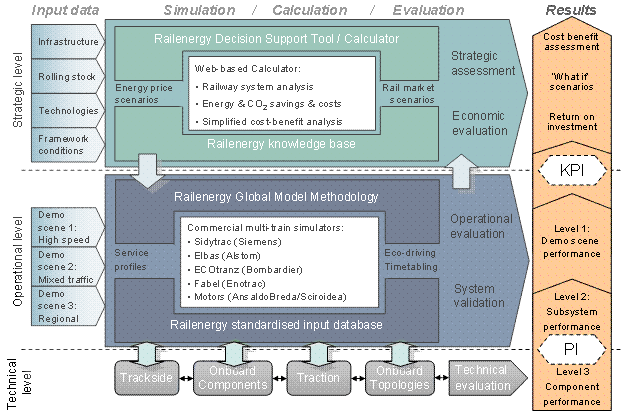
Railenergy assessment methodology
The studied technologies have first been simulated at the technical level and technology assessment reports have been elaborated.
At the operational level the energy savings of the different technologies’ have been simulated. The energy simulations are performed on selected lines and operation (so called demo scenes and use cases) by commercial multi-train simulation tools used in a harmonised and transparent way, the so-called global modelling methodology. The energy saving potential is measured in Railenergy Key Performance Indicators (KPI’s) defined in the first phase of the project. The simulation results are described in evaluation reports per use case or service type.
The interpretation and transfer of realistic energy saving potentials from the actual performed simulations in the use cases to other combinations of service types and energy supply types has been done by experts and stored in Technology Potential Tables (TPT) for each technology showing the characteristics of savings.
At strategic level an economic evaluation and strategic assessment is performed regarding the energy saving potential for the different technologies and service types. The economic assessment methodology is described in more detail in chapter 4.
The technologies are identified and linked to different scenarios depending on which railway segment and possible development in the relevant segment. The two scenarios are: 1. Business as usual and 2. additional efforts. The strategic assessment methodology is described in more detail in chapter 5. The results from the strategic assessments are documented in four result reports (SARs) connected to this methodology report for the following rail services: 2. DC, 3. AC conventional, 4. AC high-speed and 5. diesel.
The results from the strategic assessment are then used to calculate the Railenergy target fulfilment where the target is to reduce the specific energy consumption in the European railways by 6 % in 2020 assuming that Railenergy technologies are deployed in approximately 25 % of railway services in Europe.
System boundaries
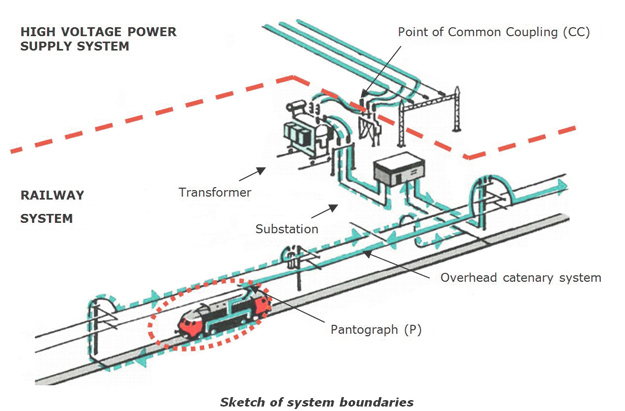
System boundaries separate rail specific infrastructure from other types of infrastructure and thus define the railway system. In terms of electric infrastructure the boundary separates rail specific electric infrastructure or railway distribution grid consisting of transformers, substations and overhead catenary system (OCS), and high voltage power supply system.
This boundary or the point of separation is called “point of common coupling (CC)” and is shown in Figure 4. The energy consumption at this point defines the system level/ consumption. Another boundary which is important to be clarified is the point separating the train within the railway system. This boundary is located at the pantograph (P) of the train and is shown in Figure 4. The energy consumption at this point defines the train level consumption.
In Railenergy all technologies and operational measures investigated are evaluated on system level. This means that energy saving potential is evaluated at the commonly agreed system boundaries with the measurement point at the “Point of Common Coupling” for electric railways and the diesel fuel tank for diesel powered railways (see figure 1 below). For AC 15kV systems with separate high voltage grid for railways (like in Germany, Austria, Switzerland etc.) the “Point of Common Coupling” is defined as the inlet of the substation feeding directly the railway grid and overhead catenary lines with 15kV.
The energy saving potentials are tested by using simulations performed on selected lines and operation – so called demonstration scenes and use cases – by commercial multi-train simulation tools used in a harmonised and transparent way. This is the backbone of the so-called Railenergy Global Modelling Methodology. In the following sections the key performance indicators as well as the simulation and evaluation methods are described.