
High Speed AC Rail Services
Recommendations for Operational Measures
The recommendations for high speed operation would fall into two parts for "in service" operation: one is similar to AC conventional recommendations for the operation taking place on conventional lines with mixed traffic; the other one is for operation on dedicated high speed lines. Finally, the "out of service" mode recommendations are similar to the ones given for AC conventional.
- Eco driving (levels 1 and 2, see technology description for details) is highly promising, like for the other types of power supply. It has a saving potential between 3% and 10% depending on the actual operational regime and on the level of sophistication of the introduced system.
- Energy efficient traffic management (eco-driving level 3) will allow significant reductions in energy consumption in the railway system (between 10% and 14%). The implementation of such systems requires a high degree of cooperation between the different stakeholders – infrastructure managers, train operating companies, rolling stock and signalling equipment manufacturers and standardisation bodies and safety authorities. The needed joint effort goes clearly beyond the "business as usual" scenario. A reasonable degree of standardisation is needed in order to guarantee swift progress in this field.
- Parked train management is a very promising operational measure with a high saving potential (2% to 5%) and comparably low investment costs. It mainly focuses on a more efficient load and temperature management for parked trains and can be realized as a first stage by low tech measures. More complex systemic solutions require higher investments and a higher organisational effort because established processes and habits have to be changed.
The following figure gives an overview over the qualitative dependence of level of complexity and amortization time for promising operational measures and thus represents an implementation perspective for energy saving measures:
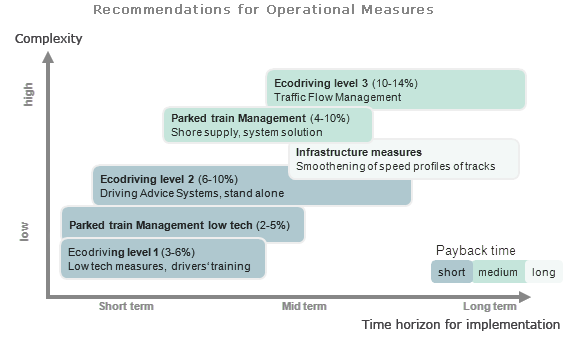
Qualitative dependence between level of complexity and time frame for implementation time of operational measures
Recommendations for Infrastructure Measures
European high speed networks are AC networks except for a few shorter distances with DC 3kV which is not expected to grow due to poor performance compared to AC. This means that the main recommendations for AC networks are equal to the ones of the AC conventional services. For DC networks the recommendations will be focussed on upgrade of existing infrastructures.
- Since AC systems and especially the modern 25kV systems are already energy efficient, the improvement options are rather limited. Because of relatively high effort and investment costs for infrastructure measures, payback times would be far too long, if the measures would be implemented for energy efficiency reasons only.
- Nevertheless, it makes sense to include potential energy savings in the LCC assessment of upgrading measures for the catenary or for the dimensioning of new AC supply systems. Under specific conditions the reduction of the overhead line impedance by means of additional wires, bigger cross sections or alternative materials can pay off in the long run if a higher capacity of the line is either actually needed or at least anticipated in the near future.
- The integration of reversible substations and/or trackside energy storage units shall be considered for networks with medium traffic density but it is unlikely to play a role for the remaining DC 3kV high speed networks.
Recommendations for Rolling Stock Measures
- The UIC/UNIFE TecRec 100_001 "Specification and verification of energy consumption for railway rolling stock" should be used for all new projects in the tendering process as basis for prediction and evaluation of the energy performance of new technologies or design options.
- For older generation high speed train sets motor flux management is a very promising efficiency technology with a saving potential at system level between 2% and 5%. Since it can be mostly done by software changes only or by minor hardware changes, it is very profitable and has a low payback time. The related energy savings are.
- Equally promising for such older train sets is the energy management of auxiliaries (MV load management). Investment costs and complexity of changes are comparably low resulting in short payback times. Saving potential is between 2 and 6%. Since both motor flux and MV load management are highly profitable and have short payback times, they can be also applied to rolling stock with a shorter remaining life time.
- Medium frequency energy distribution is an interesting technology to follow for new AC high speed rolling stock. It has an energy saving potential between 3% and 6%. Investment costs are relatively high and some open questions (e.g. integration) still have to be solved. The same could be said for superconducting transformers if it was not for the significant development and field testing still remaining before real implementation can successfully take place.
The following figure gives an overview over the qualitative dependence of level of complexity and pay-back time for promising HS efficiency technologies:
Qualitative dependence between level of complexity and time frame for implementation of HS efficiency technologies